
West Hollywood, CA has some of the most aggressive climate goals in the country; its 2021 Climate Action and Adaptation Plan calls for carbon neutrality by 2035. With buildings accounting for about 60% of the city’s attributable greenhouse gas (GHG) emissions, the City knows it can’t hit those targets without serious action in the built environment.
On December 1, 2025, the City adopted a new ordinance establishing mandatory building energy benchmarking and a building performance standard called Equitable Building Performance Standard (EBPS). Here’s our breakdown of the ordinance details.
What the ordinance requires
- Covered buildings: City, commercial, and multifamily (more than 5 units) over 20,000 sq. ft.—just over 300 buildings. Residential condos are exempt from performance standards but still covered by benchmarking.
- Two steps: (1) annual benchmarking → (2) increasingly stringent performance standards over time, with flexibility pathways.
- Performance metrics: the City will set standards by property type using site energy use intensity (site EUI) and/or GHG emissions intensity (GHGI).
- Emissions ambition: Final standards must collectively reduce covered-building aggregate GHG emissions by at least 80% by 2035.
- Goals beyond climate😯: The ordinance explicitly links upgrades to healthier indoor/outdoor air, comfort, resilience, and the potential for lower energy bills and operating costs.
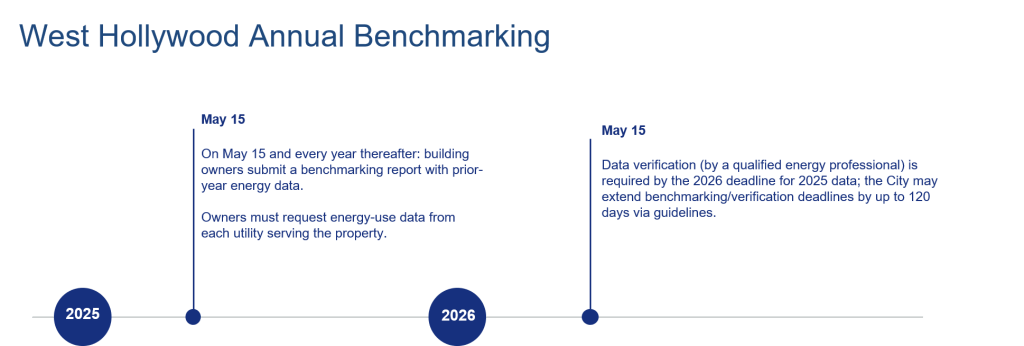
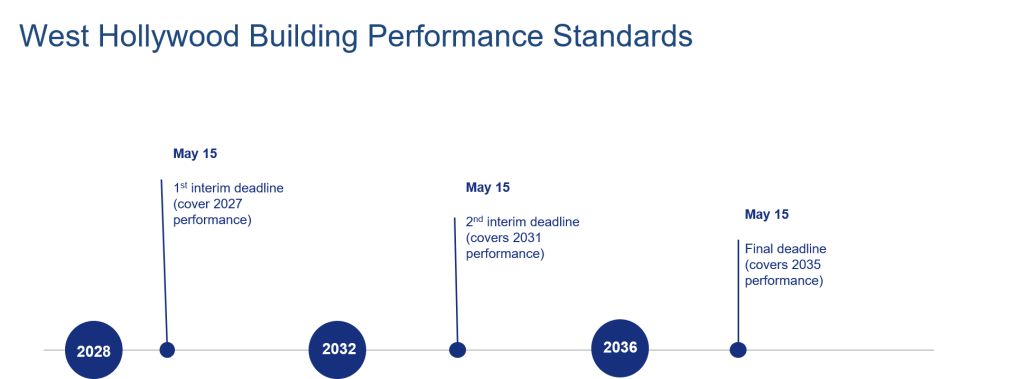
Compliance Timelines
This is an extremely ambitious BPS‼️
West Hollywood’s EBPS is not just “benchmark-and-share.” It is designed to force meaningful performance outcomes—fast.
1) The emissions target is steep
The ordinance directs that standards collectively reduce GHG emissions 80% by 2035 for covered buildings.
2) The City is telegraphing deep electrification
The ordinance’s findings note that ~80% of the City’s existing residential building stock must be electrified by 2035 to reach carbon neutrality.
3) Penalties are designed to bite
- Missed benchmarking can trigger a citation/fine up to $1,000.
- Missed performance standards (without an approved plan) can trigger annual fines equal to the social cost of carbon for each unachieved CO2e reduction, with values set in a City fee resolution and subject to periodic increases.
- The “worst-case” scenario—missing benchmarking and performance and lacking an approved plan—can lead to an added penalty up to $10 per square foot of gross floor area, assessed annually until compliance (or plan approval).
The compliance “escape valve” is real—but not easy
Owners get two pathways:
- Building Performance Pathway (BPP): Meet the standard by the deadline and maintain it until the next milestone.
- Building Performance Action Plan (BPAP): If an owner can’t reasonably meet an interim standard, they can submit a BPAP—but BPAP is not available for final compliance (final must be met via BPP). IMT recommends that building owners with unusual circumstances be permitted to submit BPAPs to apply for adjustments to their final BPS targets. IMT will publish in mid-2026 a recommended model alternative compliance pathway (ACP) regulatory framework (including BPAPs) for BPS. You can read more about the landscape of ACPs in our July 2025 report: The Landscape of Building Performance Standard Pathway Alternatives.
BPAP requirements are rigorous: a retrofit measure timeline plus a cost-benefit analysis using utility tariffs and forecasted rates, an audit or retrocommissioning report, and a distributed energy resources (DER) opportunity report using National Laboratories of the Rockies’s REopt tool (or another approved method).
The hard part: enforcement and implementation capacity
This is where the policy’s ambition collides with reality. Ensuring compliance will be extremely challenging. West Hollywood has already issued an RFP to contract out implementation needs—which can be common for jurisdiction to do, but it raises the stakes for program design. Contracting out implementation can work well, but for the policy to succeed, the City’s EBPS regulations and administrative guidelines must be crystal clear and operationally realistic because the vendor(s) will build the workflows, software setup, help desk scripts, and enforcement steps exactly from what’s written. If the program design is vague or overly complex, you risk inconsistent decisions, owner confusion, delays, and harder-to-defend enforcement once penalties kick in.
Even with contractors, the City will need to operationalize (at minimum):
- A clear administrative guidelines package that defines standards by property type, data rules, and submission protocols
- A credible verification and QA process (including how the City handles discrepancies)
- A BPAP review workflow (audits, cost-benefit review, REopt outputs) that is consistent and defensible
- An enforcement playbook that is fair, predictable, and administratively feasible—especially with fines tied to the Social Cost of Carbon
What building owners should do in 2026
- Treat benchmarking like a compliance system, not a one-off report: utility data requests, tenant data flows, and ENERGY STAR Portfolio Manager workflows need to be repeatable.
- Line up a verifier early and do a “dry run” on 2025 data quality before the May 2026 deadline.
- Start scoping retrofit pathways now (commissioning, controls, envelope, electrification readiness), because all three deadlines are fast approaching (starting with 2027!); it can take years to design, permit, and install building improvements; and BPAPs require real documentation and analysis—not vibes.
West Hollywood’s EBPS is strong on ambition—but the next 12–18 months will determine whether it’s also strong on implementation and enforcement.