By Casius Pealer
Increased borrowing costs, driven by a misunderstanding of risk, are a central challenge to scaling up investments in building efficiency and renewables. These investments are still relatively unfamiliar to financial institutions, and that means a high risk premium for loans. As the federal government pulls back support for green lending, local leadership is critical to fill the gap. The good news is that community development financial institutions (CDFIs) offer a critical path forward, especially for low-income communities. What’s more, regional network building can create a bottom-up, durable, and scalable approach to changing the risk assessments for lending.
For over 30 years, mission-driven financial institutions—local banks, credit unions, and loan funds—have consistently delivered affordable interest rates to underserved urban, rural, and Native communities. Today there are over 1,400 CDFIs certified by the U.S. Department of Treasury that manage over $222 billion in loans. Those CDFIs leverage $8 in private sector funds for every $1 in public or philanthropic funding in order to scale up impact based on their specialized financial and community expertise.
This track record of community impact was the reason that the 2022 Inflation Reduction Act offered federal funding to reduce greenhouse gas emissions through regional green banks and existing community lenders. While national political priorities have changed and these specific federal funds are suspended in legal disputes, the fundamental local value proposition remains the same: building lender capacity and knowledge will reduce operating costs, mitigate future risks, and advance community goals around climate impact and resilience.
The challenge is making sure that lenders understand the connection between sustainability activities, community welfare, and risk management. To this end, IMT is leading a pilot program to build lender capacity for green financing in Southeast Pennsylvania, supported by the William Penn Foundation and the Green Family Foundation.
Southeastern Pennsylvania community lender learning cohort

Altering norms around green financing means getting an influential contingent of industry professionals to assess risks differently. While there are robust online trainings for community lenders nationally, and there are some funding programs which offer direct technical assistance to individual lenders, IMT identified a key gap. There is no regional cohort training that addresses building decarbonization or green lending. Closing that gap is more about building relationships and trust over time than it is about imparting technical knowledge. That’s why, in the summer of 2025, IMT partnered with the Philadelphia Green Capital Corp, Building Energy Exchange (BE-Ex), and local partners to launch a learning cohort for community lenders in Southeastern Pennsylvania.
An initial 12-member cohort walked through core building and finance topics like energy modeling, construction administration, underwriting, and co-lending. The sessions were interactive and structured to build connections among the participants. As facilitators of these discussions, we learned a number of lessons ourselves. Here are our key takeaways:
1. Be specific about how this work advances the lender’s mission
CDFIs are mission-driven entities, generally focused on social and community impact. Any climate-related work needs to advance the organization’s core mission. While there are many ways in which environmental and social impacts overlap and are mutually reinforcing, it is important for organizations to be explicit about these connections internally as well as externally.
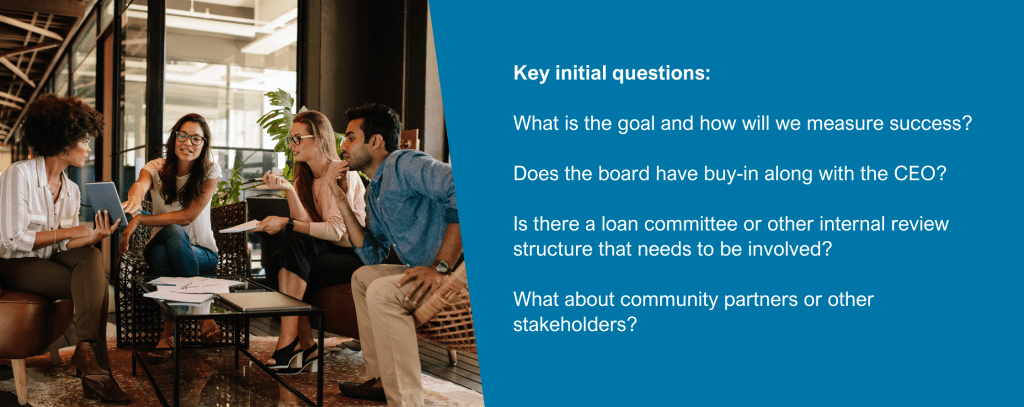
Simply training loan officers or underwriters on green financing will not produce results without larger organizational awareness and support.
These are questions that will differ for each organization and need to be answered before starting a new program. To facilitate these conversations, we are now working with local partners to develop a workbook that will help organizations frame questions and provide space for discussions regarding internal policies and practices, executive level support, communication, and overall priorities. This self-paced resource is designed to structure internal conversations, goal-setting, and action to implement and sustain green lending programs over time.
2. Build awareness and literacy about core building science
In a pre-cohort survey of potential topics, participants expressed the most confidence in traditional community finance activities like underwriting, co-lending, and measuring impact. They were least confident in building science topics like energy modeling, energy efficiency standards, and solar photovoltaic and battery storage loans. While this result might be obvious, it reinforced the need to grow basic awareness and literacy in these core building science areas. This will help community lenders to fully engage with these topics where they interact with traditional deal structuring and underwriting expertise and can inspire them to advance more green loans.
For example, lenders in our cohort expressed initial uncertainty about the need for efficiency and sustainability building inspections and certifications. But learning about these activities through real life examples—including walkthroughs and photographs of poorly installed or missing insulation—showed that basic building inspections are often insufficient. Efficiency and sustainability certifications and inspections result in operating savings, occupant comfort and tenant satisfaction, and, ultimately, lower risks for lenders holding the property as collateral. Ensuring these inspections are planned, done properly, and appropriately documented is a critical part of the lender’s assessment, which helps owners and property managers give these actions the priority level they deserve.
3. Speed up loan approval and project delivery
Another lesson was that time is often as important as money. In general, a borrower is not looking for a loan but rather looking to solve a problem. So the solution can’t create more problems (delays).
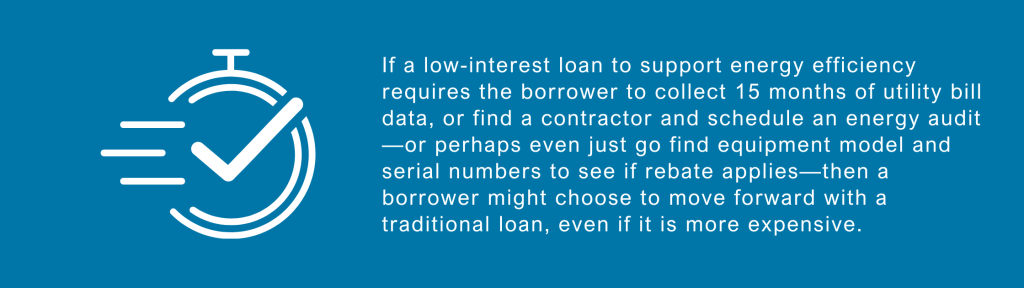
As a result, it’s important to help borrowers not only meet their immediate needs, but also to shift their mindset to prepare for future projects and equipment upgrades. Lenders can play a key role in this shift by helping borrowers plan for future regulatory compliance needs, suggesting changes to lease provisions that help align operating savings with capital expenses, identifying space and capacity needs for eventual solar installations, and generally increasing awareness of the requirements for rebates and incentives. Working with borrowers in this way frames efficiency and clean energy projects in the context of capital planning that is already a need for every building, and sets the stage for success over time.
4. Provide lenders with tools for action
Community lenders don’t need to be experts in building science, but they do need to be aware of some key terms, understand what due diligence items they should collect, and know when and who to ask for these things. IMT is creating simplified checklists for loan officers that don’t require them to become experts in things like energy modeling, building certifications, or data collection.
For example, when hiring an HVAC contractor, do they have an EPA-recognized credential for HVAC contractors, or Air Conditioning Contractors of America Energy Star Certification? When the project has an energy model, is it primarily to assess long-term savings or is it mainly for a building certification or incentive program? If reviewing savings, which utility costs does the owner actually pay? When should the lender expect a post-construction inspection report, and what, if anything, should they be looking for in that report? Knowing the answers to these questions makes lenders better at assessing risks and opportunities for property improvements.
What’s next?
Based on our experience in southeastern Pennsylvania, IMT is developing a workbook for community lenders along with local partners New Ecology, Green Building United, and the Philadelphia Green Capital Corporation, and national partner BE-Ex. This resource will include general topics and questions, but also locally-relevant information on building codes, policies and incentives, and local building practices. Together we will be offering topic-specific local trainings to connect community lenders with building professionals, and also facilitating a second cohort of lenders using this workbook.

This approach can scale to different locations across the country. We could run future cohorts in other regions with CDFI ecosystems or for different state Housing Finance Agencies, and can teach other facilitators to lead their own cohorts using the workbook and the tactics we’ve learned. As the co-founder of the Building Performance Partnership, IMT has developed relationships with real estate professionals and lenders in major cities nationwide. Through IMT’s relationships with community-based organizations in these locations, and others, we can connect the dots on better buildings that meaningfully improve lives for residents and communities.
The bottom line is that green lending principles and community lending values are already aligned. We can expand the impact and reach of this lending by building local relationships and community leadership along with technical expertise. In the absence of near-term federal leadership and funding, economic fundamentals and local commitment continue to drive this work forward. In pursuit of a more just and sustainable future, we need to activate the strong, existing network of CDFIs and connect it to the larger shift in real estate toward improving both existing and new buildings.